
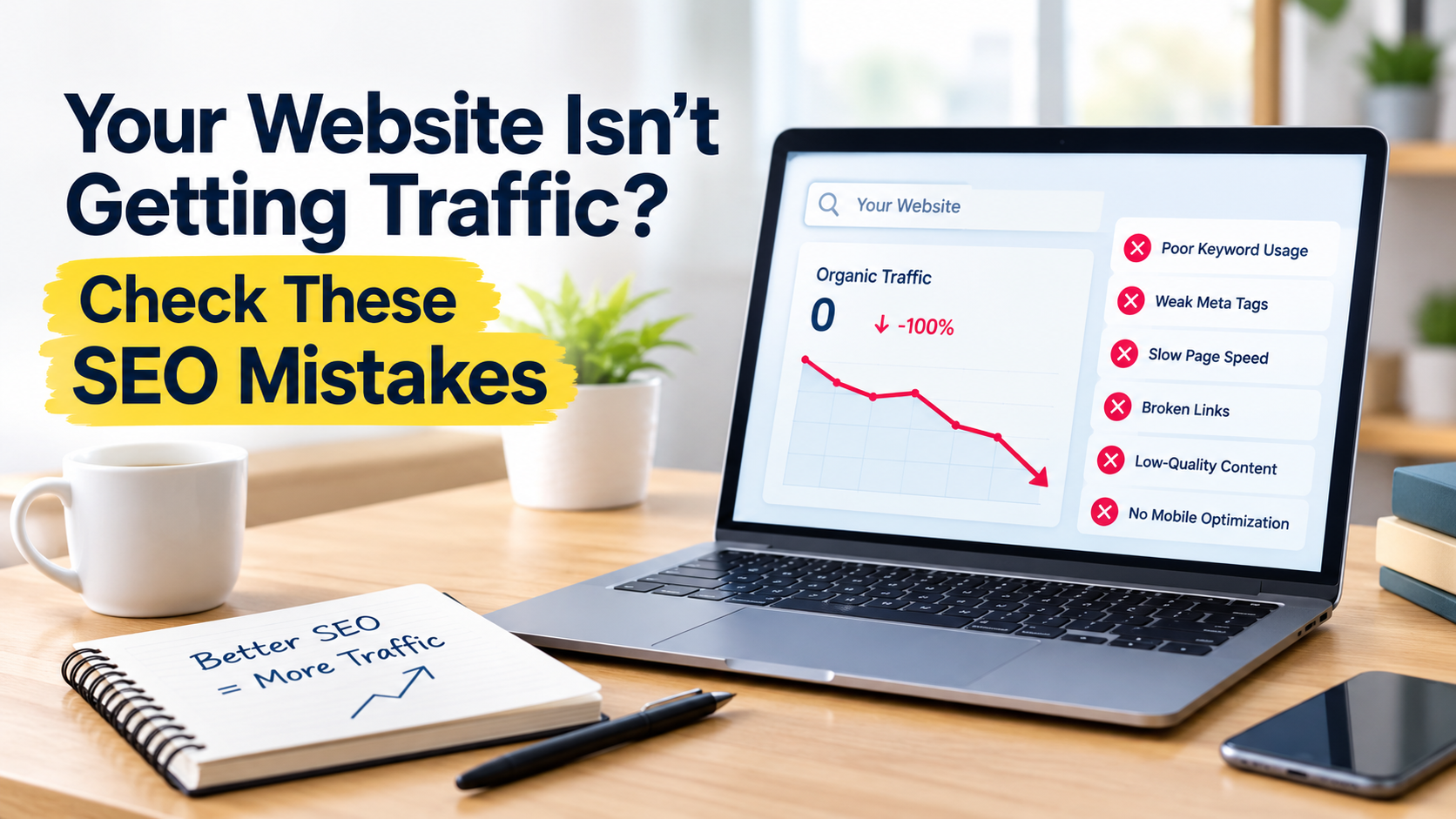
You may publish content regularly, optimize your pages, and build backlinks, yet your website may still struggle to get organic traffic. Why? Often, the problem is not a lack of effort but a few SEO mistakes that are easy to overlook.
From choosing the wrong keywords to ignoring technical issues, mobile experience, local SEO, or competitor research, small problems can affect how users and search engines understand your website.
The good news is that most common SEO mistakes can be identified and fixed with a clear strategy.
13 Common SEO Mistakes You Should Avoid
1. Targeting the Wrong Keywords
Choosing keywords only because they have high search volume is a common mistake. A keyword may be popular but too competitive or unrelated to your audience.
Consider relevance, search intent, competition, and whether the keyword can attract potential customers.
For example, a local bakery may target “birthday cakes in Noida” instead of competing for the much broader term “cake.”
2. Keyword Stuffing
Repeating the same keyword throughout an article does not automatically improve SEO. It can make your content difficult and unnatural to read.
Use your primary keyword naturally and include related terms where they make sense. Good SEO content should always prioritize the reader.
3. Ignoring Search Intent
Search intent means understanding what users actually want when they search.
Common types include:
- Informational: “What is technical SEO?”
- Navigational: Searching for a specific website or brand
- Commercial: Comparing products or services
- Transactional: Ready to buy or take action
Before creating content, check the search results for your target keyword. This helps you understand what information users expect.
4. Publishing Thin or Low-Value Content
Short content is not automatically bad, but content without useful information is unlikely to satisfy readers.
Create original, relevant, and practical content that answers the user's question.
This is also where Google E-E-A-T is useful as a content-quality framework. Experience, Expertise, Authoritativeness, and Trustworthiness can be demonstrated through first-hand knowledge, accurate information, credible sources, clear authorship, and regularly updated content.
5. Poor Title Tags and Meta Descriptions
Titles and meta descriptions help users understand what a page is about.
Avoid vague titles such as “Our Services.” Instead, make them descriptive and relevant to the page.
Your meta description should briefly explain the page and encourage the right searcher to visit it. Clear snippets can improve relevance and click-through potential, although they do not guarantee higher rankings.
6. Ignoring Technical SEO
Technical problems can make it harder for search engines to crawl and index your website.
Common technical SEO mistakes include:
- Broken links
- Incorrect redirects
- Duplicate pages
- Indexing problems
- Poor website structure
- Incorrect canonical tags
- Sitemap issues
Use tools such as Google Search Console and website crawlers to identify and fix important technical problems.
7. Slow Website Speed
Slow pages can frustrate visitors, especially on mobile devices.
Improve performance by compressing images, reducing unnecessary scripts, improving caching, and monitoring Core Web Vitals.
The goal is not simply to achieve a perfect score but to provide a fast and stable experience.
8. Not Optimizing for Mobile Users
Many people access websites through smartphones. If your text is too small, buttons are difficult to tap, or navigation is confusing, visitors may leave quickly.
Use responsive design and test important pages on different screen sizes. Make sure text, menus, forms, images, and buttons work comfortably on mobile.
9. Ignoring Internal Linking
Internal links connect related pages on your website. They help visitors discover more content and help search engines understand your site's structure.
For example, an article about keyword research can naturally link to a related guide about on-page SEO.
Use descriptive anchor text and link only to genuinely relevant pages.
10. Building Low-Quality Backlinks
More backlinks do not always mean better SEO.
Links from irrelevant or questionable websites may provide little value and can create unnecessary risks. Instead, focus on earning relevant links through useful content, industry resources, partnerships, digital PR, and genuine relationships.
Quality and relevance are more important than simply counting links.
11. Ignoring Local SEO
Local businesses can lose valuable visibility by ignoring location-based search.
Common local SEO mistakes include incomplete business information, inconsistent contact details, weak location targeting, and an incomplete Google Business Profile.
Keep your business information accurate, maintain your profile, encourage genuine customer reviews, and create useful local content.
Businesses can also consider local SEO services when they need help managing local visibility or multiple locations.
12. Not Updating Old Content
Old content can become less useful when statistics, links, products, or search intent change.
Review older pages regularly. Update outdated information, replace broken links, improve weak sections, add relevant internal links, and check whether the content still matches what users are searching for.
Refreshing useful content can often be more practical than constantly publishing new pages.
13. Skipping Competitor Research
Ignoring competitors can make it harder to identify opportunities.
Competitive analysis in digital marketing can help you understand competitor keywords, content topics, search intent, backlinks, SERP features, and user experience.
For example, if competing pages provide detailed examples and FAQs while your page only offers a short explanation, that difference can reveal an opportunity to improve.
Competitor research should help you learn from the market—not copy another website.
How to Fix Common SEO Mistakes
If your website has several problems, fix them systematically:
- Audit your website.
- Review your target keywords.
- Check search intent.
- Improve existing content.
- Fix technical SEO issues.
- Improve speed and mobile usability.
- Strengthen internal linking.
- Review backlink quality.
- Improve local SEO signals.
- Analyze competitors.
- Update outdated content.
- Monitor performance regularly.
Start with problems affecting important pages and user experience.
When Should You Consider Professional SEO Help?
Professional SEO support may be useful when your website has persistent technical problems, poor organic visibility, difficult keyword competition, local visibility challenges, or a large number of pages requiring regular audits.
If you are comparing an SEO Company in Noida, look at its experience, services, reporting process, communication, and understanding of your business goals.
Be cautious about anyone promising guaranteed rankings or instant traffic. Ask what work they will actually perform and how results will be measured.
Simple SEO Mistakes Checklist
Use this quick checklist:
- Are your keywords relevant?
- Does your content match search intent?
- Is your content genuinely useful?
- Does it demonstrate credibility?
- Are your pages technically accessible?
- Is your website mobile-friendly?
- Are important pages fast?
- Do you use useful internal links?
- Are your backlinks relevant?
- Is your local information accurate?
- Have you researched competitors?
- Are old articles updated?
- Are you monitoring SEO performance?
Frequently Asked Questions
What are the most common SEO mistakes?
Common problems include keyword stuffing, targeting irrelevant keywords, ignoring search intent, publishing low-value content, technical errors, poor mobile usability, weak internal linking, and low-quality backlinks.
How do I fix SEO mistakes on my website?
Start with an SEO audit. Review keywords and search intent, improve content, fix technical issues, optimize mobile experience, strengthen internal links, and monitor your results.
What SEO mistakes should beginners avoid?
Beginners should avoid keyword stuffing, buying questionable backlinks, copying competitors, ignoring technical SEO, and expecting immediate results.
Does keyword stuffing hurt SEO?
Keyword stuffing can make content unnatural and difficult to read. Use keywords naturally and focus on providing useful information.
How often should I audit my website?
There is no fixed schedule for every website. Regular monitoring is useful, while larger or frequently changing websites may need more frequent audits.
Conclusion
SEO is more than keywords and backlinks. Strong SEO requires useful content, relevant keyword targeting, technical health, mobile usability, internal linking, quality backlinks, local optimization, and regular updates.
By identifying these common SEO mistakes and fixing them step by step, you can create a website that is easier for both users and search engines to understand.
Focus on helping your audience first, monitor your performance, and keep improving your website over time.