
Publishing blog posts regularly is no longer enough to build a strong presence in Google search. People want information that is accurate, useful, original, and trustworthy. At the same time, businesses need to show visitors that they genuinely understand their subject and can be trusted.
This is where Google E-E-A-T becomes important.
Whether you run a small business website, personal blog, online store, or professional service website, understanding what is Google E-E-A-T can help you create better content and a stronger online reputation. For example, a business working with an SEO Company in Noida may focus on rankings, keywords, and backlinks, but sustainable SEO also requires content that demonstrates genuine knowledge and credibility.
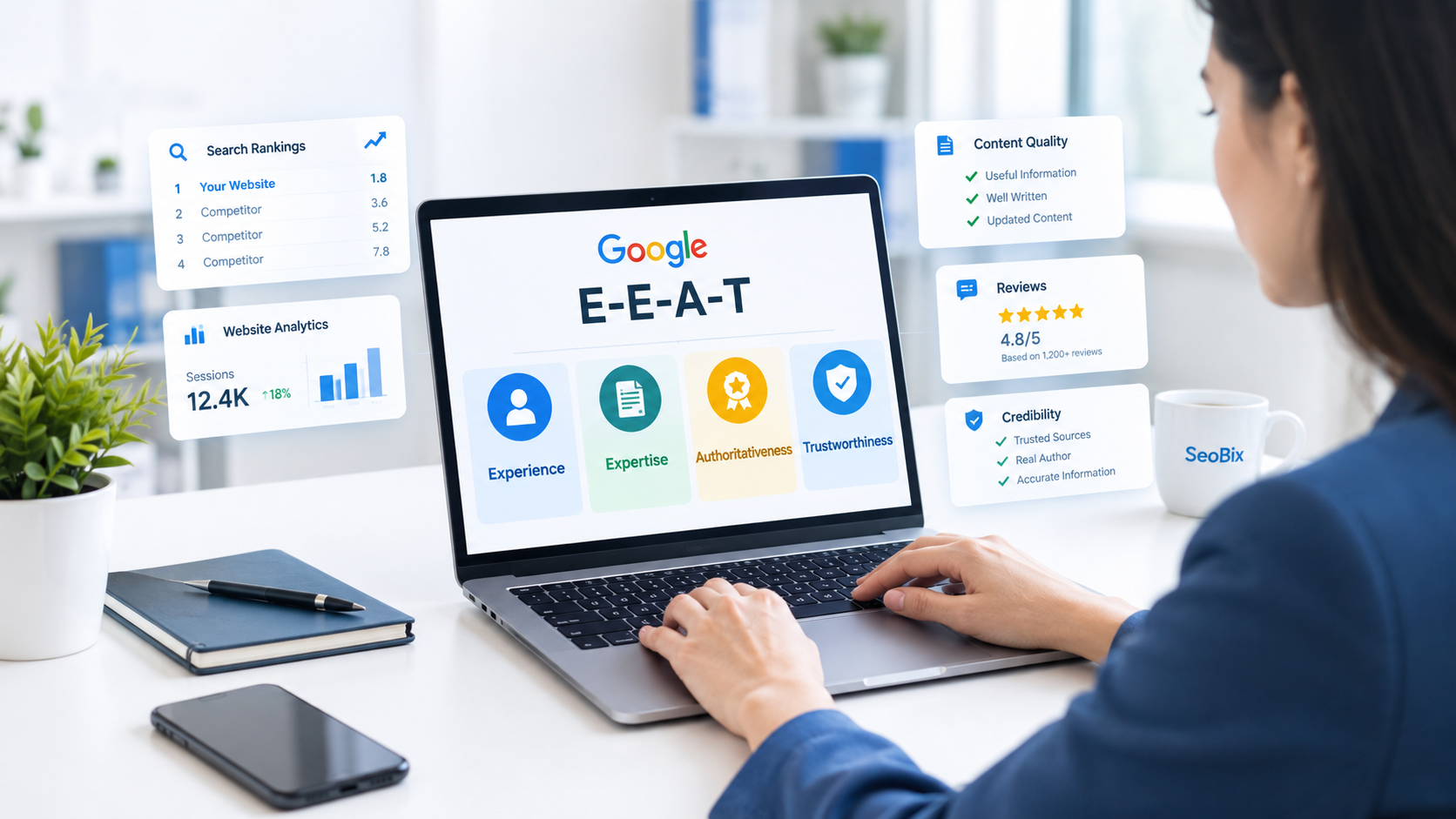
E-E-A-T stands for Experience, Expertise, Authoritativeness, and Trustworthiness. It is a framework used in Google's Search Quality Rater Guidelines to help human quality raters evaluate the quality of search results.
Importantly, E-E-A-T is not a single Google ranking factor or score that website owners can directly optimize. Instead, it is a useful way to think about the qualities that make content and websites valuable to users.
What Is Google E-E-A-T?
The E-E-A-T meaning becomes easier to understand when each letter is considered separately:
- Experience: Has the creator actually experienced the subject?
- Expertise: Does the creator have appropriate knowledge or skill?
- Authoritativeness: Is the creator, website, or organization recognized as a reliable source?
- Trustworthiness: Can users trust the content, website, and organization behind it?
Together, these principles help explain what high-quality content should look like.
For example, a travel blogger writing about a destination they personally visited can demonstrate experience through original photographs, practical observations, and first-hand recommendations. A financial article, meanwhile, may benefit from clear authorship, accurate information, appropriate expertise, and references to reliable sources.
Why Does E-E-A-T Matter for SEO?
E-E-A-T matters because search users need more than content containing the right keywords. They need answers they can understand and rely on.
Strong E-E-A-T in SEO can contribute to:
- Better content quality
- Greater user confidence
- Stronger brand credibility
- More transparent authorship
- Better customer trust
- More useful website experiences
- A sustainable long-term SEO strategy
This becomes particularly important for topics that can affect people's health, finances, safety, or overall well-being. These topics are often referred to as Your Money or Your Life (YMYL) topics and require especially strong attention to accuracy and trust.
For businesses, building website trust and credibility can also influence whether visitors feel comfortable contacting the company, making a purchase, or recommending the brand.
The Four Components of E-E-A-T Explained
Experience
Experience refers to first-hand experience in SEO and other subject areas, products, services, or situations.
Imagine two websites reviewing a camera. One provides specifications copied from the manufacturer's website. The other includes original photographs, real-world testing results, advantages and disadvantages discovered during use, and practical observations.
The second example demonstrates stronger experience because the creator has actually interacted with the product.
Businesses can demonstrate experience through case studies, project examples, original images, customer stories, demonstrations, and practical insights.
Expertise
Expertise means demonstrating appropriate knowledge about a particular topic.
Expertise can be shown through professional qualifications, work experience, research, detailed explanations, or consistently accurate content. However, formal credentials are not always necessary for every topic.
For example, someone who has spent years restoring vintage furniture may have valuable practical expertise even without an academic qualification in furniture restoration.
The key is to provide information that demonstrates genuine content expertise rather than simply repeating information found elsewhere.
Authoritativeness
Authoritativeness relates to how trustworthy and recognized a source is within its subject area.
Relevant mentions, reputable references, quality backlinks, expert contributions, positive reputation, and recognition from other credible sources can all contribute to a website's perceived authority.
For instance, a local marketing agency that regularly publishes useful research, earns mentions from respected industry websites, and demonstrates successful projects can establish stronger website authority over time.
Authority should be earned through valuable work rather than manufactured through manipulative tactics.
Trustworthiness
Trustworthiness is arguably the most important part of E-E-A-T.
A website can have knowledgeable writers and plenty of backlinks, but users still need to feel safe and confident using it.
Important trust signals include:
- Accurate and updated information
- Clear contact details
- Transparent business information
- Secure website connections
- Honest product or service descriptions
- Genuine customer reviews
- Reliable references
- Clear authorship
- Easy-to-understand policies
If a website makes exaggerated promises or hides important information, its credibility can suffer.
How E-E-A-T Has Changed Modern Content Marketing
Modern content marketing is increasingly focused on usefulness rather than simply producing large amounts of text.
Google's guidance emphasizes helpful, original, people-first content. This means businesses should create content because it solves a genuine problem or answers a real question—not simply because a keyword has search volume.
AI and automation can be used as writing or research tools, but simply generating large quantities of generic content is not a replacement for knowledge, originality, accuracy, or human judgment. Google's focus remains on the quality and usefulness of the content, regardless of how it was produced.
Instead of asking, "How many articles can we publish?", businesses should ask:
"What can we teach our audience that is genuinely useful?"
That change in mindset can significantly improve SEO content quality.
How to Improve E-E-A-T on Your Website
If you are wondering how to improve E-E-A-T, start with practical improvements rather than trying to optimize for an imaginary E-E-A-T score.
Add Author Information
Use clear bylines and author bios where appropriate. Explain the writer's relevant experience, knowledge, or qualifications.
Demonstrate First-Hand Experience
Share original examples, photographs, case studies, experiments, customer experiences, or practical lessons.
Use Reliable Sources
Support important claims with credible and relevant sources. Avoid presenting uncertain information as fact.
Keep Content Updated
Review older articles regularly. Remove outdated information and update statistics, recommendations, examples, and references when necessary.
Strengthen Your About Us Page
An informative About Us page can help visitors understand who operates the website, what the organization does, and why it is qualified to provide its services.
Show Genuine Reviews
Real customer reviews and testimonials can strengthen online business credibility. Never use fabricated reviews or misleading testimonials.
Improve Website Security
Use HTTPS and make sure users can easily find important information such as contact details, policies, and business information.
Build Relevant Reputation
Earn quality backlinks, industry mentions, partnerships, and references by creating content people genuinely want to cite and share.
Google encourages website owners to consider the Who, How, and Why behind their content: who created it, how it was produced, and why it exists.
E-E-A-T for Small Businesses
For smaller companies, E-E-A-T can be an excellent opportunity to compete through authenticity rather than trying to look like a huge corporation.
Effective small business trust building can begin with simple actions such as showing the people behind the business, sharing customer success stories, publishing useful FAQs, and demonstrating local knowledge.
Consider adding:
- Customer case studies
- Genuine testimonials
- Original business photographs
- Expert-written blog posts
- Behind-the-scenes content
- Local industry insights
- Detailed service explanations
- Helpful FAQs
For example, a local home renovation company could publish before-and-after project photographs, explain its process, share customer experiences, and answer common renovation questions. This provides much more value than publishing generic articles filled with keywords.
How SEO Services Can Support E-E-A-T
Professional SEO can support the technical and content foundations that make a website easier to understand, discover, and use.
For example, SEO Services in Noida may include activities such as:
- Technical SEO improvements
- Keyword research and strategy
- Content optimization
- Internal linking
- Website structure improvements
- Local SEO
- Competitor research
- Content planning
- Reputation-focused strategies
SEO professionals cannot simply "add E-E-A-T" to a website or guarantee higher rankings. Instead, they can help identify weaknesses and create a strategy that supports better content quality, usability, visibility, and credibility.
The strongest approach combines SEO expertise with genuine business knowledge.
Common E-E-A-T Mistakes to Avoid
Some common mistakes can weaken a website's credibility:
- Publishing generic content with little original value
- Hiding author information
- Making unsupported claims
- Leaving important information outdated
- Copying competitors
- Excessive keyword stuffing
- Creating content only to attract search traffic
- Publishing topics without appropriate knowledge
- Using fake reviews or testimonials
- Ignoring website security
- Hiding important business information
Avoiding these problems is often just as important as adding new content.
E-E-A-T Checklist for Website Owners
Use this quick checklist to review your website:
☐ Does important content have clear authorship?
☐ Does the content demonstrate real experience?
☐ Are important claims supported by reliable sources?
☐ Is your business information transparent?
☐ Are customer reviews genuine?
☐ Is your website secure?
☐ Does your content provide original value?
☐ Is outdated information regularly reviewed?
☐ Can visitors easily contact your business?
☐ Does your website clearly communicate who created the content, how it was created, and why it exists?
If several answers are "no," those areas can become priorities for improvement.
FAQs About Google E-E-A-T
What is Google E-E-A-T?
Google E-E-A-T stands for Experience, Expertise, Authoritativeness, and Trustworthiness. It describes important qualities used when evaluating content and website quality.
Is E-E-A-T a Google ranking factor?
E-E-A-T is not a single, direct Google ranking factor or numerical score. It is better understood as a framework for evaluating the quality and credibility of content.
What are the four parts of E-E-A-T?
The four parts are Experience, Expertise, Authoritativeness, and Trustworthiness. Trust is especially important because users need confidence in the information and website they are using.
How can I improve E-E-A-T?
Create original and useful content, demonstrate first-hand experience, use reliable sources, provide clear authorship, maintain accurate information, show genuine reviews, and make your website transparent and secure.
Why is trust important for SEO?
Trust helps users feel confident about the information, products, or services provided by a website. A trustworthy website also creates a stronger foundation for long-term content and SEO efforts.
Does E-E-A-T matter for small businesses?
Yes. Small businesses can demonstrate E-E-A-T through local expertise, customer experiences, case studies, original content, transparent business information, and genuine relationships with their audience.
Conclusion
Understanding what Google E-E-A-T is ultimately about understanding what makes online information genuinely useful and trustworthy.
Experience shows that you understand a subject in the real world. Expertise demonstrates knowledge. Authoritativeness establishes recognition and reputation. Trustworthiness gives users confidence in your website and information.
Rather than treating E-E-A-T as another SEO score to chase, use it as a quality framework. Create people-first content, demonstrate genuine experience, provide accurate information, be transparent about who is behind your website, and consistently put your audience's needs first.
When these principles become part of your content strategy, E-E-A-T and SEO work together naturally to support a more credible, useful, and sustainable online presence.