If your website is not ranking well or not anymore receiving adequate traffic, you must seriously identify what is occurring on the background. This is where SEO audit services come in. The audit does not tell you what is broken: the audit helps you to really understand what needs to be changed for the better performance of your sites in search engines.
Often, SEO seems intimidating; however, an audit makes it all clear. It's like a full check-up for your site. You will know what's in good health and what needs to be treated to get things going smoothly again.
What Are SEO Audit Services?
SEO audit services are designed to examine every part of your website that affects your search engine performance. From how fast your pages load to how well your content matches search intent, these audits give you a detailed report of what’s working and what’s not.
The goal? To improve your website optimization, boost organic traffic, and help you rank higher on search engines.
A full audit covers many areas, including:
Technical SEO (site speed, mobile usability, crawl errors)
On-page SEO (title tags, keywords, content quality)
Off-page SEO (backlinks, authority, referring domains)
User experience (navigation, layout, page performance)
SEO reporting and action plan (what to fix, why, and how)
Technical SEO (site speed, mobile usability, crawl errors)
On-page SEO (title tags, keywords, content quality)
Off-page SEO (backlinks, authority, referring domains)
User experience (navigation, layout, page performance)
SEO reporting and action plan (what to fix, why, and how)
This process gives you a complete picture of your website’s current SEO health and a clear strategy to improve it.
The Role of SEO Reporting
What makes an audit helpful is not the information; it's what you do with it - this is why detailed SEO reporting is important. With a detailed and thorough SEO report, you won't be adrift in a sea of numbers. You'll know what is holding your site back, and you'll know what to do next. You won't be left wondering if you should rewrite all your copy on the site, improve the site's page speed, or address a technical issue. A report will serve as your custom SEO map.
A well-designed report also measures progress over time. After making the requisite changes, you'll be able to measure improvements based on diagnosis improvements like ranking improvements, or improved user experience, or an increase in traffic.
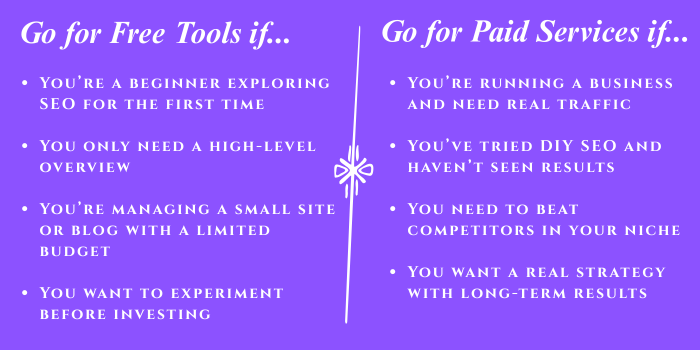
Choosing Between Free and Paid: What’s Right for You?
Now the big question: should you go with a free website SEO audit tool or invest in professional SEO audit services?
Here’s a quick way to decide:
Go for Free Tools if...
You’re a beginner exploring SEO for the first time
You only need a high-level overview
You’re managing a small site or blog with a limited budget
You want to experiment before investing
You’re a beginner exploring SEO for the first time
You only need a high-level overview
You’re managing a small site or blog with a limited budget
You want to experiment before investing
Go for Paid Services if...
You’re running a business and need real traffic
You’ve tried DIY SEO and haven’t seen results
You want expert help, not just data
You need to beat competitors in your niche
You want a real strategy with long-term results
You’re running a business and need real traffic
You’ve tried DIY SEO and haven’t seen results
You want expert help, not just data
You need to beat competitors in your niche
You want a real strategy with long-term results
The difference comes down to this: free tools give you data, paid audits give you direction.
Website Optimization Begins with a Strong Foundation
This begins with an observation of the current state of your site. An audit will let you know if the website has been built on solid foundations. Making sure pages load fast, look good on mobile devices, and are easy to navigate, among other things, constitutes site optimization. An excellent audit will help you combine all these aspects.
Slow loading of your website, and customers leave. If the content does not match what users are looking for, Google will not display it in response. If your technical SEO is broken, people may never see the pages listed on your website. Hence, auditing and optimizing are two different sides of the same coin.
Who Needs SEO Audit Services?
Whether you’re a small business owner, blogger, eCommerce brand, or agency, if you rely on search traffic, you need regular audits.
It’s especially important if:
Your website traffic has dropped recently
You’ve redesigned your site or changed its structure
Your content isn’t ranking despite good effort
You’ve never done an SEO audit before
You want to improve your overall website optimization
Your website traffic has dropped recently
You’ve redesigned your site or changed its structure
Your content isn’t ranking despite good effort
You’ve never done an SEO audit before
You want to improve your overall website optimization
While DIY audits provide some degree of insight, they can never compete with professional audits. And with the growing competition in SEO, it’s imperative to take action based on real data!
Final Words: Take the First Step Toward Better SEO
There is no secret, just a straightforward process that we need to follow if we want to rank #1 on Google. It starts by assessing the current state of your site, and what is holding it back from success. That is what SEO audit services are designed to do.
Don't take a guess and go blindly into trends get a person-specific understanding of the strengths and weaknesses of your site. Take that assessment to create a better content strategy, improve your site structure, and create a more optimized user experience.